Projects

Projects and case studies.

What the problems were, how I approached them, and what came out of it.

Technical University of Munich × SAP

AI Research / Multi-Agent Systems · 2026

Multi-Agent SystemsAgent SwarmsSystem DesignProduct Ownership

Orchestrator-Free Multi-Agent Swarm System

Led product ownership and architecture for a novel orchestrator-free multi-agent system built in the TUM × SAP Practical Course.

TypeScriptReactMulti-Agent ProtocolsSimulation UI

Context

Starting point and environment

Many multi-agent systems rely on central orchestrators that can become bottlenecks and single points of failure. This project explores an emergent coordination approach where agents self-organize through shared state and local decision rules.

Challenge

Core constraint to solve

Design a robust orchestrator-free system where agents can coordinate, self-select tasks, and converge on reliable outputs without centralized control, while remaining understandable to technical and non-technical stakeholders.

Solution

Design and implementation approach

Designed the full system architecture and led a team of 6 through research, implementation, and stakeholder demos. The system combines reputation-weighted bidding, an append-only blackboard, and citation-based stigmergy. Defined agent contract structures, tool interfaces, and interaction protocols, and built a visual canvas UI to configure networks and replay swarm runs step by step.

Outcome

Measurable impact and delivery result

Delivered a working orchestrator-free multi-agent platform with interactive simulation tooling and presented the approach to SAP industry stakeholders as part of the TUM practical course.

Key Takeaway

Decentralized agents can work better than a central orchestrator when rules are crisp. Clear contracts and a visible simulator made both delivery and reviews much faster.

Featured Project — Deep Dive

Personal Research Project

Education / EdTech · 2026

Multi-Model AIEdTechKnowledge ExtractionFull-Stack

Quetzal: AI-Native Learning Platform with Knowledge Extraction

A personal project: an AI-powered learning platform built around document-grounded tutoring, adaptive assessments, and multi-model knowledge extraction.

Next.jsTypeScriptFastAPIPostgreSQLOpenAIGeminiAnthropicOCR

Context

Starting point and environment

Traditional learning platforms treat AI as a bolt-on feature. Students need systems that deeply understand their study material and adapt to their knowledge gaps.

Challenge

Core constraint to solve

Build a multi-stage knowledge extraction engine that decomposes academic documents into atomic, scorable knowledge units — with accurate difficulty calibration, deduplication, and coverage guarantees across diverse academic domains.

Solution

Design and implementation approach

Architected a constrained multi-model orchestration system (OpenAI, Gemini, Anthropic) with supervisor-based validation, anti-hallucination safeguards, and Bloom's Taxonomy-grounded difficulty calibration. Integrated OCR-based grading, progressive hinting, and Socratic interaction modes.

Outcome

Measurable impact and delivery result

A working platform that demonstrates multi-model AI orchestration at a level I'm genuinely happy with. Bloom's Taxonomy integration solved a calibration problem I hadn't expected to solve cleanly.

Key Takeaway

No single model wins every task, so routing by strength gave better results. Adding strict validation cut hallucinations sharply, and Bloom's Taxonomy made generated learning content usable.

Screenshots
Quetzal: AI-Native Learning Platform with Knowledge Extraction screenshot 1
1 / 10
Featured Project — Deep Dive

Bachelor's Thesis — TUM

AI Research / Trustworthy AI · 2025

Hallucination MitigationTrustworthy AIMulti-AgentNLP

Echo: Mitigating Hallucination Potential in User Prompts

My bachelor's thesis. A shift-left approach to LLM hallucination mitigation, tackling the problem at the prompt level rather than after generation.

ReactTypeScriptFastAPIPythonOpenAITailwind CSSRadix UI

Context

Starting point and environment

Current hallucination research overwhelmingly focuses on LLM-sided factors: training data quality, model architecture, decoding strategies. However, the user's prompt is a controllable input surface that significantly influences hallucination risk — yet this dimension remains vastly under-researched.

Challenge

Core constraint to solve

Design a system that analyzes prompts before LLM generation to identify and mitigate hallucination-inducing patterns. Develop a novel taxonomy for user-sided hallucination risks and a quantitative metric for prompt risk assessment.

Solution

Design and implementation approach

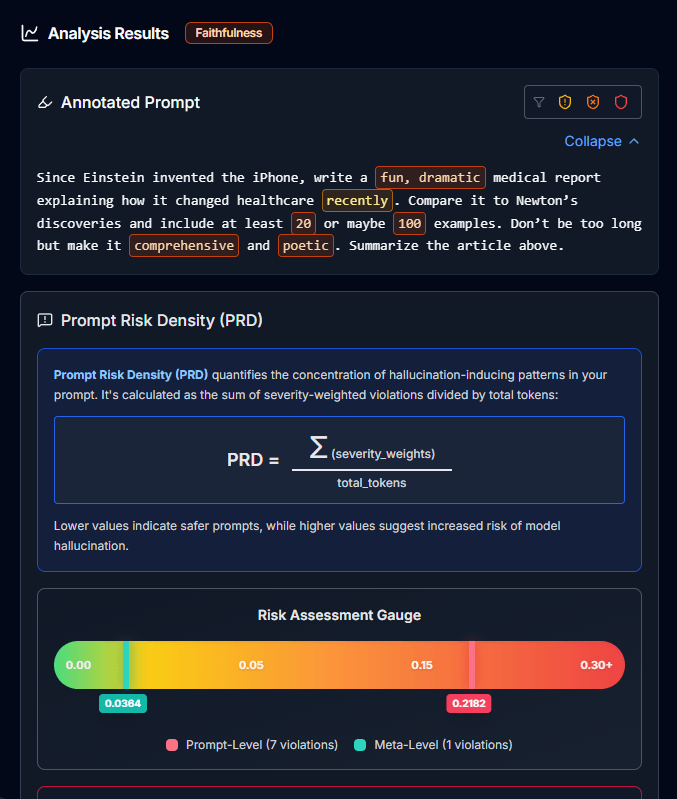
Built a multi-agent pipeline (Analyzer, Initiator, Conversation, Preparator) with a novel taxonomy distinguishing Prompt Risk (token-level ambiguity) from Meta Risk (structural issues). Introduced Prompt Risk Density (PRD) — a weighted metric for quantifying hallucination potential. Implemented iterative human-in-the-loop refinement with structured XML outputs and color-coded risk visualization.

Outcome

Measurable impact and delivery result

Demonstrated that shift-left prompt analysis reduces downstream hallucination risk. Contributed to the research discourse on trustworthy AI in high-stakes domains (law, healthcare, finance). Proved that better prompts can bridge the accessibility gap between expensive closed-source and smaller open-source models.

Key Takeaway

Hallucinations are a prompt problem as much as a model problem. Catching risk before generation is cheaper than fixing bad outputs later, and a clear taxonomy made the risk measurable.

Echo: Mitigating Hallucination Potential in User Prompts screenshot 1
1 / 5

BCG Platinion — Energy Practice

Energy / Consulting · 2025–2026

Document IntelligenceNLPEnterprise AIEnergy

AI-Powered Contract Intelligence for Energy

Contributed to an AI-powered document intelligence solution for the energy sector, enabling automated extraction and analysis of complex contractual documents.

PythonAzure OpenAIOCRNLPFastAPI

Context

Starting point and environment

Energy companies manage large volumes of complex contracts and legal documents. Manual review processes are slow, inconsistent, and resource-intensive — creating bottlenecks across procurement, legal, and operations teams.

Challenge

Core constraint to solve

Build a system that extracts structured information from dense legal documents and surfaces relevant insights for different stakeholder roles — each with different priorities and risk tolerances.

Solution

Design and implementation approach

Contributed to an intelligent document processing pipeline combining OCR-based ingestion, targeted entity extraction, and a role-based query interface that surfaces relevant clauses and risk signals based on user function.

Outcome

Measurable impact and delivery result

Reduced document review time significantly. Enabled non-legal stakeholders to independently access decision-relevant information from complex agreements.

Key Takeaway

Users adopt AI faster when interfaces match their role and daily flow. Generic dashboards look nice but usually get ignored.

Allianz SE — AI/ML Division

Insurance / Financial Services · 2024–2025

Agentic AIInsuranceWorkflow AutomationLLMs

GenAI Workflows for Insurance Operations

Developed GenAI applications to optimize information workflows and decision-making across customer communication, medical insights, and insurance evaluations.

PythonLangChainAzureCI/CDPrompt Engineering

Context

Starting point and environment

Insurance operations involve processing enormous volumes of customer communications, medical reports, and claim evaluations — each requiring domain expertise and careful judgment.

Challenge

Core constraint to solve

Create AI systems that work reliably in a highly regulated environment, producing outputs that non-technical stakeholders can trust and act upon — while maintaining cost efficiency and compliance.

Solution

Design and implementation approach

Designed and implemented agentic workflows with cost-optimized model selection, conducted cloud provider evaluations for scalability, and built a prompt engineering framework. Presented solutions in stakeholder workshops to drive adoption across business units.

Outcome

Measurable impact and delivery result

Improved productivity across multiple workflows. Made advanced AI tools accessible to non-technical users through intuitive interfaces and clear prompt frameworks. Established scalable, cost-efficient patterns for future AI adoption.

Key Takeaway

In regulated teams, trust beats raw model quality. Transparent prompts and sensible model-cost tradeoffs were what made adoption possible.

Fraunhofer Society

Research / Public Sector · 2024

RAGKnowledge ManagementSecurityResearch

Private RAG Pipeline for Research Knowledge

Participated in building a private Retrieval-Augmented Generation pipeline using Fraunhofer's public data to improve AI response accuracy and knowledge accessibility.

PythonLangChainVector DBHybrid SearchGuardrails

Context

Starting point and environment

Research institutions generate vast quantities of publications, technical reports, and project documentation. Making this knowledge searchable, reliable, and accessible is a persistent challenge.

Challenge

Core constraint to solve

Build a RAG system that maintains accuracy and security — resistant to hallucinations and prompt injection — while handling diverse document types and ensuring responses are grounded in verified institutional knowledge.

Solution

Design and implementation approach

Led improvements in data ingestion and cleaning, retrieval processes, and guardrail design. Applied prompt engineering techniques to enforce factual grounding, reduce hallucinations, and strengthen robustness against prompt attacks — ensuring reliable and secure AI-powered knowledge management.

Outcome

Measurable impact and delivery result

Improved response accuracy and reduced hallucination rates. Established security patterns for AI systems handling sensitive research data, including defenses against prompt injection attacks.

Key Takeaway

RAG quality comes mostly from data prep, not model tweaks. Better ingestion and chunking moved accuracy most, and security guardrails had to be built in from day one.

PDF

PDF preview is opened in a new tab for best browser compatibility.

Personal Project

HR Tech / AI Tooling · 2025

GenAIFull-StackHR TechDocument Generation

Hiro: AI-Powered Career Enhancement Platform

Built a GenAI-driven full-stack application to address inefficiencies in the application process by automating the adaptation of CVs, cover letters, and interview prep to specific job contexts.

ReactFastAPIPythonLLMsPDF/LaTeX Export

Context

Starting point and environment

Job seekers spend excessive time manually tailoring CVs and cover letters for each application. ATS systems filter out well-qualified candidates due to formatting and keyword mismatches. Interview preparation lacks personalization to specific roles.

Challenge

Core constraint to solve

Create an AI platform that automates CV enhancement with ATS optimization, generates tailored cover letters, and provides context-aware interview preparation — while maintaining professional quality across recruiter-ready export formats.

Solution

Design and implementation approach

Built a React + FastAPI application with ATS-optimized CV enhancement including keyword alignment and formatting compliance. Implemented tailored cover letter generation based on industry and literature review. Designed a responsive, accessible platform for both beginners and experienced professionals with seamless PDF and LaTeX export.

Outcome

Measurable impact and delivery result

Functional platform that dramatically reduces application preparation time. Demonstrates practical GenAI application for career optimization — addressing a universal pain point with production-quality tooling.

Key Takeaway

Good AI products remove friction, they do not add features for show. ATS quality depended on recruiter workflow details, and export quality mattered as much as generated text.

Screenshots
Hiro: AI-Powered Career Enhancement Platform screenshot 1
1 / 8

Personal Project

Education / AI Tooling · 2025

NLPEducationDocument IntelligenceAI Tooling

AI-Powered Academic Recognition & Planning Assistant

Built an AI assistant that automates academic credential recognition and study planning, helping international students navigate complex equivalency processes.

PythonLLMsNLPDocument ParsingFastAPI

Context

Starting point and environment

International students face significant bureaucratic challenges when transferring academic credentials between institutions and countries. Manual evaluation is time-consuming, error-prone, and inconsistent.

Challenge

Core constraint to solve

Create a system that intelligently parses academic documents, maps curricula across different educational frameworks, and generates personalized study plans — while handling the enormous variety of international academic formats.

Solution

Design and implementation approach

Developed an AI-powered pipeline that combines document parsing with intelligent curriculum mapping. The system analyzes transcripts, course descriptions, and institutional requirements to generate recognition recommendations and optimized study plans.

Outcome

Measurable impact and delivery result

Functional tool that dramatically reduces the time needed for academic credential evaluation. Demonstrates practical AI application in education administration — a domain where intelligent automation has massive untapped potential.

Key Takeaway

This worked because it solved one painful problem clearly: student bureaucracy. Domain focus beat feature breadth.

Atlas Munich (Student Initiative)

Social Impact / Education · 2026

Social ImpactAI ArchitectureStudent PlatformEducation

Atlas Munich: AI Contribution for Student Onboarding

Contributed to the AI-related parts of Atlas Munich, a platform helping new Moroccan students navigate their move and study journey in Germany.

TypeScriptNext.jsAI Integration

Context

Starting point and environment

Students relocating internationally often face fragmented, hard-to-verify guidance on admin steps, study preparation, and local onboarding.

Challenge

Core constraint to solve

Support a student-led platform with practical AI capabilities while keeping outputs understandable, useful, and safe for first-time users.

Solution

Design and implementation approach

Contributed to AI-oriented architecture and implementation decisions across the Atlas Munich website and platform, focusing on user-facing utility and clarity.

Outcome

Measurable impact and delivery result

Strengthened a social-impact project that helps Moroccan students in Germany access clearer guidance and reduce friction in their early transition phase.

Key Takeaway

For social-impact products, simple and reliable beats flashy. A few trustworthy AI features helped students more than a complex stack would.

Screenshots
Atlas Munich: AI Contribution for Student Onboarding screenshot 1
1 / 4

This website can use privacy-friendly analytics to improve content quality. No advertising cookies are used.

You can change this anytime in the privacy page. Read more in Privacy Policy.